You have
a strategy.
But does it actually
work?
Finding an edge isn't that hard.
Finding a stable edge. That's where the real difficulty lies.
Be honest with yourself. You know if you've done the work.
Most traders stop at the backtest.
The prettiest equity curve is usually the most dangerous one. Overfitting doesn't fail slowly. It fails the moment it touches live data.
Looks good.
Every parameter tuned to perfection. Consistently rising. No drawdowns worth mentioning. You feel confident.
This is what overfitting looks like. It will collapse the moment it meets real market data it hasn't seen before.
Actually works.
Less perfect. More honest. Tested across multiple time windows it never saw during optimization. The drawdowns are real.
Logic behind every entry and exit. A theory that explains why it works, and more importantly, why it can stop.
"I've backtested, stress tested and run Monte Carlo simulations on perfect-looking strategies that collapsed once put into production because they had no logic behind them. They were based purely on statistics."
Why should it work?
Can you explain your edge in one sentence, without mentioning the chart? Logic always prevails over statistics. A purely mathematical edge with no explanation is unpredictable, and can stop working at any moment without warning.
Have you tested it properly?
Not just a backtest. Walk-forward, stress test, Monte Carlo. In that order. Then out-of-sample data you never touched. Then live. Each step reveals something the previous one couldn't.
Will it still work tomorrow?
An edge is never eternal. The real question isn't whether it worked in the past. It's how long it will take you to realize when it stops, explain why, and find a new one. That's what separates professionals from everyone else.
The help I wish I'd had.
Without walk-forward, stress test, Monte Carlo and out-of-sample, don't celebrate anything. 11 chapters to run them all using Claude Code, without writing a single line of code.
Inside the guide
- ✓The complete PDF, 11 chapters
- ✓11 Claude Code prompts, ready to copy-paste
- ✓A session recovery prompt
- ✓A devil's advocate prompt
- ✓Free updates
This guide is for you if
- ✓You have a strategy with defined entry and exit rules
- ✓You're not a developer and don't want to learn to code
- ✓You want proof before risking real money
- ✓You're willing to hear an honest result, even a negative one
- ✓You trade financial markets (forex, indices, stocks, crypto)
Not for you if
- ✗You're looking for a ready-made strategy or an automated signal
- ✗You trade on gut feeling without precise, repeatable rules
- ✗You want a result in 10 minutes without thinking
Six steps. No shortcuts.
Click each step to understand what it reveals and what it protects you from.
Things people say before they blow up.
"It worked for 2 months."
That's not a sample size. That's a feeling. You need years of data, multiple market regimes, and tests it never saw during optimization.
"I tweaked it until the curve looked good."
Congratulations. You found overfitting, not an edge. If you changed parameters to make the drawdown disappear, you solved the symptom, not the cause.
"The backtest looks perfect."
A perfect backtest is a red flag. Real edges have drawdowns, flat periods, and imperfect windows. Perfection means the model memorized the past.
"I only need to do the 80%."
You know deep down whether you've actually proven a strategy works or whether you've only done the 80% necessary. Don't let yourself be blinded by pretty curves.
The vocabulary of a proven edge.
Expectancy
The average amount you can expect to earn per trade over many trades. The higher and more stable it is across different market conditions, the more reliable the edge.
Walk-Forward
The only reliable way to test whether a strategy is real or overfitted. Each test window uses data the optimizer never saw.
Overfitting
When a strategy is so well-tuned to past data that it has memorized noise instead of capturing signal. The most common failure mode in quantitative trading.
Monte Carlo
Simulate your strategy 1,000 times with randomized trade order. The worst drawdown across all simulations is your true risk. Not your backtest drawdown.
An edge starts with a theory.
Not a backtest.I've spent more time going for walks alone, taking notes on whatever theories came to mind, than sitting down coding formulas in Python. That's where the real work happens.
A purely mathematical edge with no explanation is useless, even if all tests are perfect. It's unpredictable. It can stop working at any moment without warning.
Statistics are in service of ideas. Not the other way around. Theorize first. Why would the price go up? When? In what way? Then find indicators that reflect what you're looking for.
Don't add indicators randomly because you'll eventually find a good-looking strategy, but it will be overfitting.
Is your strategy actually ready?
Be honest with yourself. You know deep down whether you've actually proven it, or whether you've only done the 80%.
Can you explain in one sentence why your strategy works, without mentioning the chart?
Have you run a walk-forward optimization across multiple time windows?
Did you backtest over multiple years of data, covering different market regimes?
Have you performed a stress test: changing parameters by ±20% without performance collapse?
Have you run Monte Carlo simulations to find your true worst-case drawdown?
Do you have out-of-sample data, locked away from the start, that still holds up?
Is your expectancy positive and consistent across different market conditions?
Have you paper traded or live traded it for at least 1 month?
Did you find this edge through logic and theory, not by tweaking until it looked good?
If your strategy stopped working tomorrow, would you know why, and what to do next?
I do this to help.
It's kind of the help I wish I had when I needed it. In this field there are a lot of incompetent and ill-intentioned people. I'm just trying to tip the balance in my own small way.

Tidiane Ciavarella
I've always been passionate about sciences, asking too many questions. But one thing quickly intrigued me: probabilities. Even at a very young age, I noticed that very few people, adults and responsible people, really understood them. They had this almost supernatural quality of predicting the chances of an event happening.

Summer camp. Second place. Against adults.
I remember participating in a casino game for the first time in my life, at summer camp. That's when I realized the power of probabilities. I had found an edge that let me win consistently, because of a statistical flaw in the rules of the game. I was playing against adults, and I finished second that day. No luck. Just probabilities, statistics, and a kid a little too passionate about mathematics.
You can imagine that a few years later, when I discovered that trading existed, my eyes widened. I spent hours looking for statistical edges and backtesting them by hand. I quickly wanted to take advantage of parameter optimization, without being aware of overfitting. I quickly took my first real hits. I understood I needed a faster and more effective way to test my strategies. I had to learn to code.
So I studied mathematics and computer science at the University of Luxembourg, where I got my degree. I had the opportunity to write an 81-page scientific paper alongside the best AI researchers in Luxembourg, on adversarial attacks on CNNs.
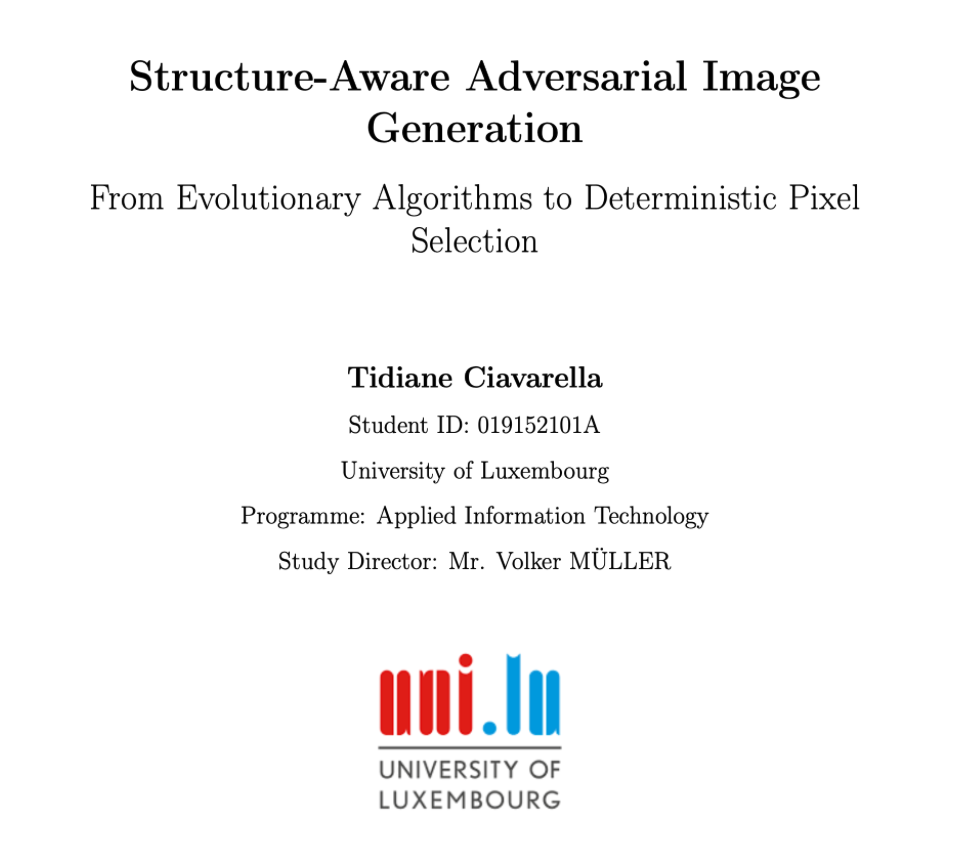
81 pages. University of Luxembourg. Adversarial attacks on CNNs.
Today I've joined all the pieces together: I code algorithms and find edges that I test properly. I've accumulated an enormous amount of losses, mistakes and failures. Trading is a fairly selfish discipline when you think about it. So I decided to share them, to help people with honest advice, as if I had to make the decision myself. No pre-built strategies or signals. I help mathematically and I put at your disposal modern solutions to test your own strategy, as I would have done.